If you have also found that it is getting harder to hire workers, labor costs are rising, and manual production is very inefficient, making disposable slippers with hand labor brings little or no profit.This article will help you understand how disposable slipper manufacturing machines can increase your profits, explain how the machines work compared with manual production, and help your factory choose the right automation solution.
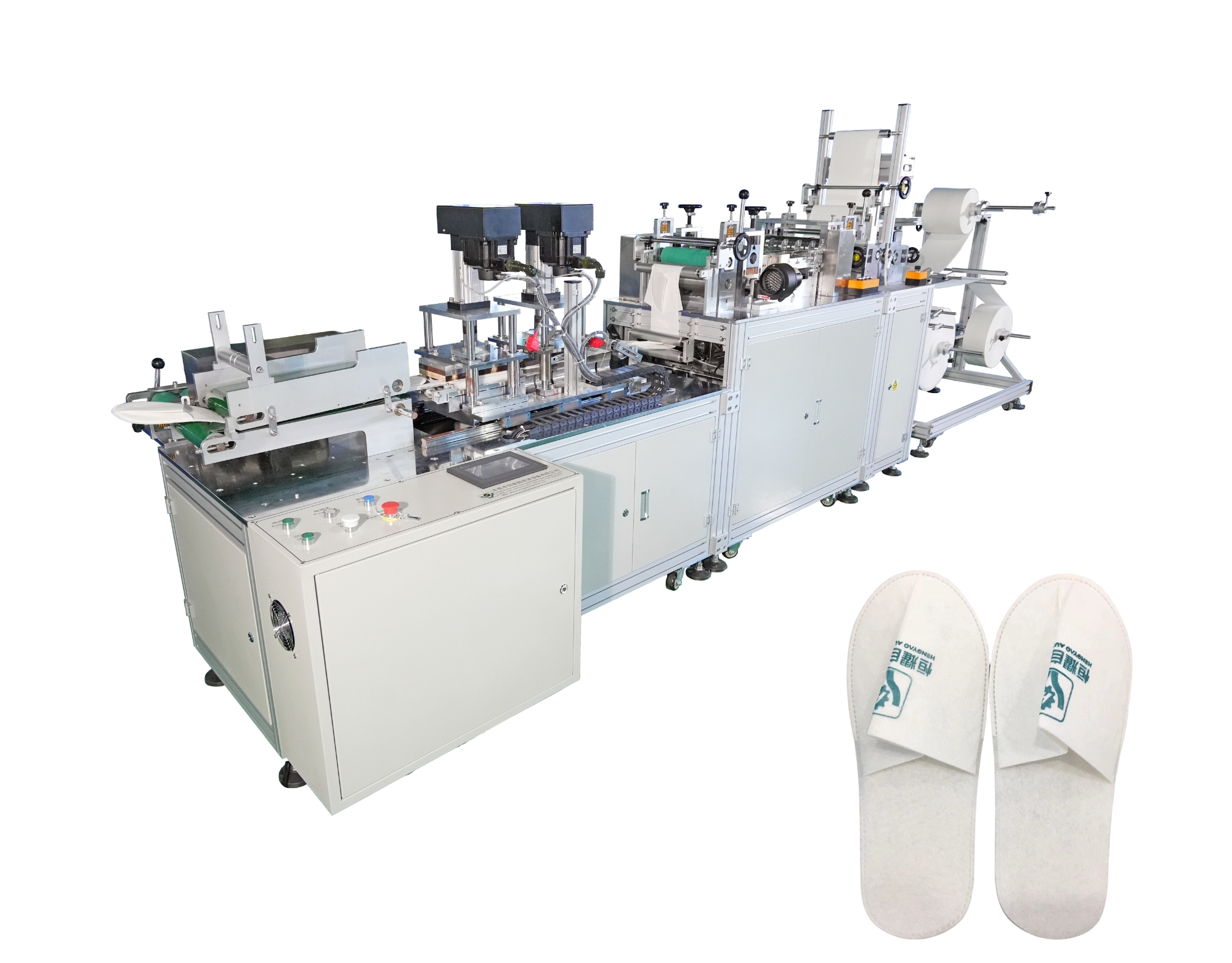
What Is a Hotel Slipper Making Machine?
A disposable slipper machine brings together production steps that were previously done by many workers into one single machine. All processes are completed automatically.
One person loads the raw materials, and the machine automatically cuts, uses ultrasonic welding, and forms the slippers, then outputs finished products. The entire process only requires one operator to monitor the machine.
Compared with traditional sewing, an automated disposable slipper machine reduces labor costs, increases production efficiency, and delivers more stable quality. It is ideal for manufacturers who need high output, high quality, and higher profits.
Why Automatic Hotel Slipper Production Is Becoming a Trend?
We reviewed several market size and forecast reports. In 2021, the global disposable slipper market was valued at USD 1.81 billion, and it is expected to grow to USD 3.19 billion by 2030. These figures are mainly based on industry reports from Grand View Research and ReportPrime.
From this data, we can see that the disposable slipper market has been growing steadily, showing strong and increasing demand. Disposable slippers are now used in more and more places, such as hotels, medical and healthcare facilities, beauty salons, gyms, airport lounges, and the rapidly growing tourism industry.
Traditional production methods can no longer keep up with this demand in terms of efficiency and quality. Manual production requires a large number of workers, and even skilled workers can only produce a few hundred pairs per day. This results in low efficiency, long delivery times, high error rates, and unstable quality.
In addition, frequent manual handling increases the risk of cross-contamination, raises the defect rate, and makes it difficult to meet modern hygiene standards. Factories also face capacity problems—short of output during peak seasons and wasted capacity during off-seasons.
A disposable slipper machine solves these problems by improving production efficiency, ensuring consistent quality, and meeting today’s hygiene requirements.
What type of disposable slippers can a disposable slipper machine produce?
Disposable slipper machines can be customised to your requirements.
This equipment can be customized to your requirements. Generally, the slippers we make use PP non-woven fabric, with 140mm pearl cotton soles, insoles, and 220mm wide uppers. We can also use double-layer composite fabrics for the slipper materials. Soles can be made with dot-contact fabric, embossed fabric, or non-slip fabric.
We can make non-woven slippers; cotton slippers; open-toe slippers; EVA slippers; natural fiber slippers; recycled paper slippers;Disposable Brushed Slippers
Sole thickness can range from 3mm to 10mm.
How should we choose between different types of equipment?
basic, mid-range, and high-end models.
Below, we will explain how to choose the right slipper production machine for your factory.
Basic Disposable Slipper Machine
The basic model is designed for standard production needs and high output. It uses ultrasonic welding for higher efficiency and can produce up to 120 pieces per minute. The slipper upper can have simple embossing and logo printing, and the machine can be connected to a packaging machine. It meets the needs of most hotels.
This model mainly works with spunlace nonwoven fabric. Material options are limited, but its biggest advantage is very fast production speed.
Mid-Range Disposable Slipper Machine
The mid-range model supports a wider range of materials. The slipper sole thickness can be from 6 mm to 10 mm, and it is compatible with multiple fabrics. It supports embossing, logo printing, and connection to a packaging machine.
The main advantage of this model is higher slipper quality and better material flexibility. Compared with the high-end model, it offers lower cost while still delivering better quality, making it suitable for mass-market customers.
High-End Disposable Slipper Machine
The high-end model can produce slippers made with brushed fabric and uses a glue bonding and edge-sealing process for a more natural and premium finish. It supports logo printing, embossing, and connection to a packaging machine.
This machine uses higher-cost raw materials and is mainly designed for high-end hotel production.
The above information is based on feedback and suggestions from our customers. You can choose the model that best fits your needs, and we can also provide customized solutions based on your production requirements.
What are the Advantages of a Disposable Hotel Slipper Fully Automatic Production Line ?
First, it replaces traditional manual sewing. The machine uses ultrasonic welding to create strong seams without needles or thread, while greatly increasing production speed.
Based on customer feedback about reducing material waste, we added sensors and two sets of web-guiding correction systems to the fabric feeding rack. This allows the machine to automatically adjust the fabric and correct deviation during high-speed operation. It prevents fabric shifting, saves raw materials, and helps increase overall product profit.
Second, the machine is equipped with seven servo motors. Each station can be adjusted independently through parameter settings, allowing precise front-and-back positioning.
Third, the cutting unit can be fine-adjusted left and right without stopping the machine. This solves alignment problems caused by machine stops, reduces fabric waste, and lowers the defect rate.
Fourth, the machine saves labor and improves efficiency. The entire automated production line only needs one operator to load materials and monitor the machine, while a traditional manual production line usually requires about seven workers.
The machine uses a PLC control system. All production parameters are clearly displayed and can be set and checked directly on the touch screen. The interface is simple and intuitive, so operators can learn it quickly.
The cutting system is highly precise, minimizing material waste. The slipper upper is formed in one piece using ultrasonic welding along the outer edge, making it stronger and cleaner in appearance. No glue or sewing thread is required, resulting in a neat and hygienic finish.
The machine can also be connected to a packaging machine and supports embossing and logo printing based on your needs, without additional processing. From raw materials to final packaging, everything is completed in one continuous process, saving significant labor and time costs.
One machine is compatible with multiple slipper styles. By simply changing the mold, you can quickly switch to producing different designs, greatly improving flexibility and overall production efficiency.
Production process for disposable slipper machines?
Material Feeding
Non-woven fabric raw materials are manually fed in roll form. Upon entering the production line, the equipment automatically corrects any misalignment, ensuring the material runs flat and straight at all times. This prevents jamming and unnecessary waste.
Cutting and Forming
The material is cut to the pre-set slipper dimensions using a die-cutting process. The resulting shoe upper edges are neat, free from fraying, and uniformly consistent.
Automatic Stacking and Bonding
Cut uppers and soles are automatically aligned and stacked via vacuum suction. Bonding is achieved through ultrasonic welding or heat pressing, eliminating stitching requirements while ensuring a secure, durable join.
Discharge and Packaging
Completed slippers are directly conveyed to packaging equipment, where they are automatically placed into bags.
How long does it take for a slipper-making machine to become profitable?
Take one of my clients as an example; the wholesale price of disposable slippers is between $0.18 and $1. After deducting raw material, labor, and operating costs, the profit margin is roughly 20% to 30%. If it's a custom-made private label, the retail price is 2 to 3 times the wholesale price. After our clients implemented automated production lines, the time it took to produce one pair of disposable slippers was reduced from 2 minutes to one pair per second, the material waste rate dropped from 12%-15% to below 3%, and the return on investment cycle for the equipment can be shortened to as short as 11 weeks.
Why Choose Hengyao Slipper Making Machine?
We are a manufacturer specialising in the research and development of non-woven fabric production equipment. Our company integrates R&D, manufacturing, assembly, sales and after-sales service, enabling us to provide customers with comprehensive solutions ranging from individual machines to complete automated production lines. Our facilities are equipped with multiple high-precision processing machines and component assembly systems sourced from Japan, Taiwan, and Switzerland. Regarding service, we provide a one-year warranty for all equipment alongside lifetime technical support. Should any issues arise during operation, our after-sales team guarantees a response within two hours, promptly dispatching technicians to diagnose and resolve the matter.



